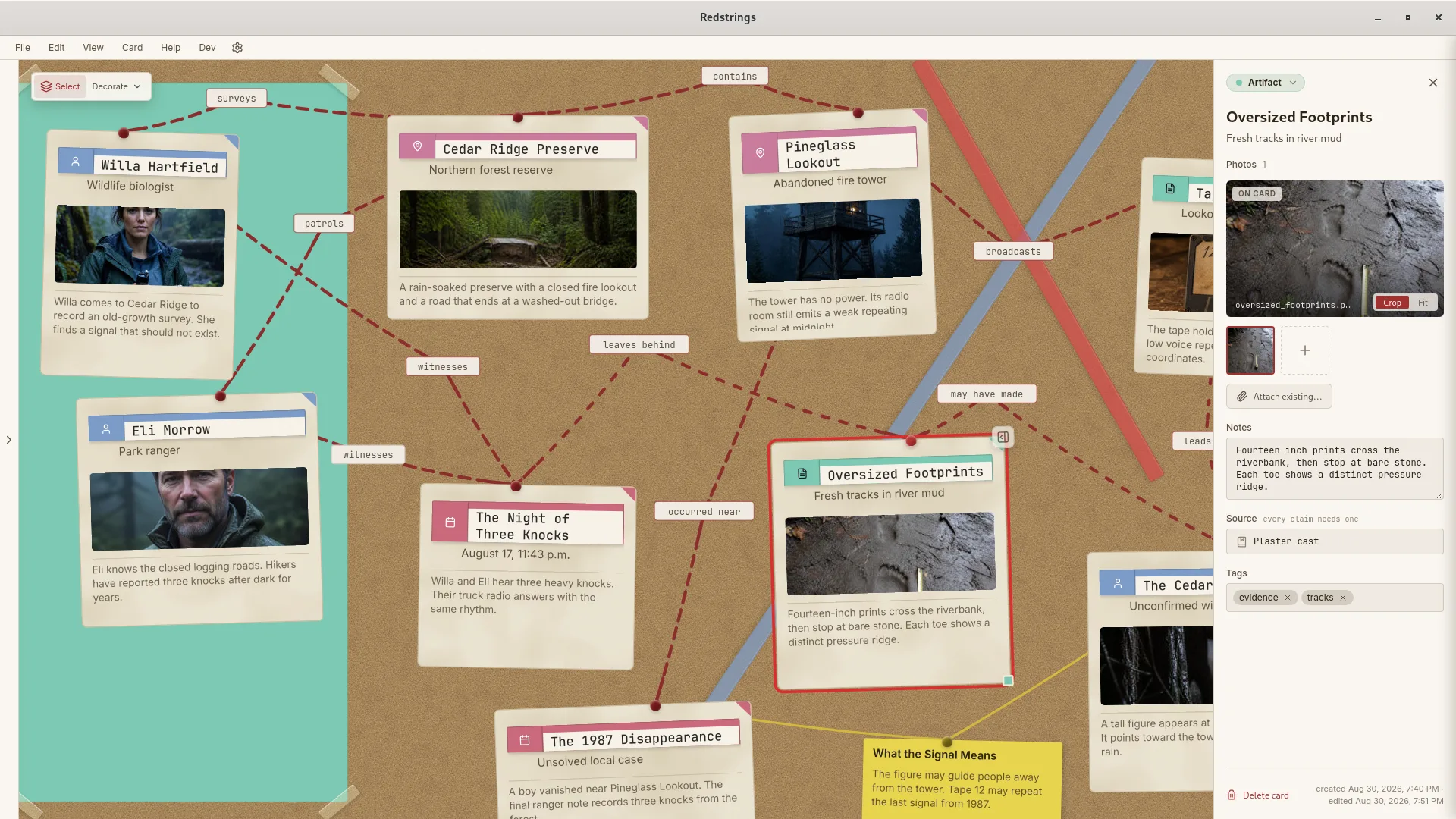
A detective board (evidence board, investigation board, or, in crime dramas,murder board) is a visual investigation tool that displays people, places, events, and evidence as cards connected by strings or lines. You've seen them in crime dramas: a wall covered with photos and documents, red strings tracing the relationships between suspects and clues.
Detective boards are also a working tool. Investigators, consultants, analysts, andresearchers use digital detective board software to organize complex cases, map relationships, and discover patterns that spreadsheets and documents hide.
What Makes a Detective Board Effective?
Detective boards work for practical reasons:
- Spatial memory. You remember where you put a card. Position becomes a cue.
- Visual connections. A string between two cards is quicker to spot than a sentence that says A relates to B.
- Pattern recognition. Step back from a populated board and clusters and gaps show up. Who connects to everyone? Who stands alone?
- External memory. A large investigation holds more facts than you can keep in your head at once. The board holds them so you can think about them.
Physical vs. Digital Detective Boards
A corkboard has limits:
- Space constraints. A wall only holds so much. Large investigations outgrow physical boards.
- Hard to reorganize. Moving pushpins and re-running strings is tedious.
- No search. Finding a specific person means scanning the whole board.
- Not portable. You can't take the wall with you.
- Security risk. Anyone who walks past can see your investigation.
Digital detective board software solves these problems:
- Large canvas. Zoom out to see the whole board, zoom in for detail. The canvas grows with the board.
- Drag and drop. Move cards to put related items next to each other and pull unrelated ones apart.
- Search. Find a card by name, notes, tags, or source.
- Multiple boards. Organize complex investigations into separate views.
- Privacy. Local-first software can keep the board in a file on your machine instead of requiring a cloud upload.
Who Uses Detective Boards?
Private Investigators
The traditional use case. Track subjects, associates, locations visited, and events witnessed. Build a visual case file that reveals connections a report would bury.
Corporate Investigators
Fraud investigations, compliance cases, and internal reviews often involve mapping relationships between employees, vendors, transactions, and documents. A board shows those links on one surface.
Management Consultants
Understanding a client organization means mapping stakeholders, influence relationships, and decision-making patterns. Consultants use detective boards to map how influence and decisions flow in practice, which often differs from the org chart.
Business Analysts
Stakeholder analysis, dependency mapping, and organizational research all benefit from visual relationship mapping. See who influences whom and where the bottlenecks are. Thestakeholder mapping guide shows the method.
Journalists
Investigative journalism requires tracking sources, documents, events, and subjects over months or years. A detective board keeps sources, documents, events, and subjects in one place for that span.
Researchers
Academic and market researchers use detective boards to map sources, track citations, and visualize relationships between concepts, authors, and findings.
Key Features of Detective Board Software
Node Types
Good detective board software lets you categorize entities. At minimum:
- Person - Individuals, suspects, witnesses, contacts
- Organization/Team - Companies, departments, groups
- Place - Locations, addresses, venues
- Event - Incidents, meetings, occurrences
- Artifact/Evidence - Documents, objects, files
- Note - Observations, theories, reminders
Labeled Connections
The strings between nodes need meaning. Label them:
- "works for" / "reports to"
- "knows" / "met with"
- "owns" / "controls"
- "witnessed" / "was present at"
- "mentioned in" / "referenced by"
Confidence Levels
Not all information is equally reliable. Mark connections as:
- Confirmed - Documentary evidence or direct observation
- Suspected - A single source or a reasonable inference
- Uncertain - Speculation or an unverified claim
Source Attribution
Track where each piece of information came from. "Per interview with J. Smith, 12/15" or "Bank records, Exhibit 4." This matters when building a case or report.
Search and Filter
As boards grow, finding specific nodes matters. Search by name, type, or content. Filter to show only certain node types.
Privacy
Investigation data is sensitive. Look for local-first software that keeps data on your machine rather than cloud servers.
How to Create a Detective Board
Step 1: Start with Your Central Focus
What's the core of your investigation? A person, an incident, a company? Place that in the center of your board.
Step 2: Add Direct Connections
Who or what is directly related to your central focus? Add those nodes and draw connections. Label each connection with the relationship type.
Step 3: Expand Outward
For each new node, ask: what else is this connected to? Let the board grow organically as you gather information.
Step 4: Note Your Sources
For each connection or piece of information, record where it came from. This builds credibility and helps you trace back later.
Step 5: Look for Patterns
Once you have 20-30 nodes, step back. What clusters do you see? Who appears in multiple contexts? Where are the gaps in your knowledge?
Reading a board this way is called link analysis.
Step 6: Reorganize for Clarity
Move related items closer together. Use spatial arrangement to communicate meaning.
Best Detective Board Software
When choosing detective board software, consider:
- Purpose-built vs. general. Tools designed for investigations have features like confidence levels and source tracking. Most general diagramming tools do not.
- Local vs. cloud. For sensitive investigations, local-first software keeps your data private.
- Desktop vs. web. A desktop app that stores files locally works without internet. A web app needs a connection.
- Pricing model. Subscription vs. one-time purchase. Some tools are free with paid upgrades.
Why Redstrings?
Redstrings is a detective board app built specifically for investigations and relationship mapping:
- 7 built-in card types - Person, Team, Artifact, Process, Place, Event, Note
- Labeled connections - Document relationship types precisely
- Confidence levels - Mark connections as Confirmed, Suspected, or Uncertain
- Source tracking - Record where information came from
- Local-first - Boards are files on your machine, with no Redstrings account or cloud sync. Optional AI analysis (Pro) sends selected board content to Google with your own Gemini key.
- Desktop app - Built on Tauri (Rust) for Windows 11 and macOS.
- Free tier - Unlimited boards, cards, and strings. Pro is a $19.99 one-time purchase that adds themes, custom card and relationship types, and AI analysis with your own key.
Download Redstrings free and start building your detective board.
Detective Board Software FAQ
Can I keep a detective board offline?
Yes. Redstrings stores project files locally, and its core board works offline. Optional Gemini analysis needs an internet connection and sends only the board content you select directly to Google.
Can I export a detective board?
Yes. Redstrings exports project files, PNG images, and Markdown reports. Use the export that suits the person or system that will receive it.
Do I need an account to use Redstrings?
No. Redstrings has no account requirement or sync service.
Explore investigation mapping
- What Is a Murder Board? How to Make One for True Crime and Mysteries
What is a murder board? Learn what goes on one and how to build it for a true-crime case, a mystery novel, or a murder mystery game.
- How to Create a Digital Evidence Board: Templates & Best Practices
Learn how to create and organize a digital evidence board for investigations. Discover evidence board templates, best practices, and software recommendations.
- Case Board Software: How to Organize Complex Investigations Visually
Learn how case board software organizes complex investigations, maps evidence and connections, and clarifies your next lead.
- Link Analysis: How Investigators Map Connections, with Methods and Tools
What is link analysis? Learn how police, intelligence analysts, and investigators map connections, and compare link analysis software and tools.
- Investigative Journalism: How to Map Sources, Documents, and the Money Trail
How investigative reporters use relationship mapping to track sources, connect documents, and follow the money, on a private local board that keeps sensitive material off the cloud.
- Best Detective Board Software in 2026: Top Investigation Board Apps Compared
Compare leading detective board apps for investigations, case management, evidence organization, and relationship mapping.