The relationship mapping guide covers tools for drawing these connections. To map a whole organization rather than one project, see the organizational mapping guide.
Stakeholder mapping is the process of identifying and visualizing the people who affect or are affected by your project, initiative, or organization. A good stakeholder map shows who matters and how they relate to each other: who influences whom, who supports or opposes your goals, and whose buy-in you need.
This guide covers the stakeholder matrix, a stakeholder mapping template you can copy, a six-step process, and how to choose a stakeholder mapping tool.
What is Stakeholder Mapping?
A list of names is the start. The map also records:
- Who - The people and groups with a stake in your work
- What - Their interests, concerns, and potential impact
- How - Their relationships with each other and with you
- Where - Their position relative to your initiative (support, opposition, neutral)
The output is typically a visual map showing stakeholders as nodes and their relationships as connections. This visual format reveals patterns that lists and spreadsheets hide.
Why Stakeholder Mapping Matters
For Consultants
Understanding client organizations quickly is essential. Stakeholder mapping helps you:
- Identify the real decision-makers, whatever their titles
- Find champions who will support your recommendations
- Anticipate resistance and prepare responses
- Navigate complex organizational politics
For Project Managers
A project needs stakeholder support at every stage:
- Know whose approval you need at each stage
- Identify dependencies between stakeholder groups
- Plan communication strategies for different audiences
- Track stakeholder sentiment over time
For Change Leaders
Organizational change requires coalition building:
- Map the formal and informal influence networks
- Identify early adopters who can influence others
- Understand resistance patterns and root causes
- Sequence conversations so early supporters bring in the next group
The Stakeholder Matrix (Power/Interest Grid)
The stakeholder matrix is a 2x2 grid used in stakeholder analysis, often called Mendelow's matrix. One axis is power: how much a stakeholder can affect the project. The other is interest: how much the outcome matters to them. Each quadrant sets a level of engagement.
- High power, high interest: manage closely. These are key players. Involve them in decisions and meet them regularly.
- High power, low interest: keep satisfied. Give them short updates and ask for input only where they have a stake. Too much detail loses them.
- Low power, high interest: keep informed. They care about the outcome and often know the detail. They can become advocates or early warnings.
- Low power, low interest: monitor. Check occasionally. Positions change when a project reaches their area.
How to Build a Stakeholder Matrix
- Score each stakeholder from 1 to 5 for power and from 1 to 5 for interest.
- Write down the reason for each score, such as budget control, veto rights, or a team the change affects.
- Place each stakeholder in a quadrant. Scores of 3 are the borderline cases; decide them with the reasons.
- Set an engagement approach and an owner for each quadrant.
- Score again at each project phase. Interest often rises as a change gets closer.
Other Stakeholder Matrix Variants
- Power/influence grid - Replaces interest with the ability to sway other people's opinions.
- Influence/impact grid - Compares how much a stakeholder can influence the project with how much the project affects them.
- Salience model - Rates power, legitimacy, and urgency. Stakeholders with all three get the most attention.
What a Matrix Cannot Show
A matrix shows each stakeholder's position. It does not show how stakeholders relate to each other. Two people in the same quadrant can be close allies or open rivals. A low-power stakeholder can be the trusted adviser of a high-power one. For that you need a map of the relationships. The techniques below and the template in the next section cover it.
Other Stakeholder Mapping Techniques
1. Influence Mapping
Focus on who influences whom, regardless of formal hierarchy:
- Draw connections showing influence relationships
- Label connections: "advises," "trusts," "defers to"
- Identify influence hubs, the people many others look to
- Find paths from your position to key decision-makers
2. Support/Opposition Mapping
Categorize stakeholders by their current stance:
- Champions - Active supporters who will advocate for you
- Supporters - Positive but not actively engaged
- Neutral - No strong opinion either way
- Skeptics - Have concerns but persuadable
- Blockers - Actively opposed
3. Network Mapping
Visualize the full relationship network:
- Show all stakeholders and their connections
- Identify clusters and communities
- Find bridge people who connect different groups
- Spot isolated stakeholders who might be overlooked
Stakeholder Mapping Template
Use this stakeholder mapping template as a starting structure. It combines the matrix scores with a relationship map, so one board holds both the analysis and the connections.
Card Types
| Card type | Use it for | Examples |
|---|---|---|
| Person | An individual stakeholder | Sponsor, budget holder, regional manager |
| Team | A group, department, or outside organization | Finance, a works council, a vendor, a regulator |
| Process | A decision, approval gate, or workstream | Budget approval, procurement review |
| Artifact | A document that carries weight | Business case, steering committee minutes |
| Event | A meeting or milestone that can change positions | Board meeting, go-live date |
| Note | An open question or observation | "Who signs off after the reorganization?" |
Relationship Labels
Label every connection with a verb, so each line reads as a statement: "Finance director approves budget approval." Start with this set and add labels as you need them:
- Formal: reports to, approves, funds, sponsors, owns
- Informal: advises, trusts, defers to, is close to
- Friction: opposes, can delay, competes with, blocks
- Dependency: depends on, needs input from
Confidence Levels
Mark each relationship as Confirmed (you saw it or it is on record), Suspected (several people suggest it), or Uncertain (one comment or a guess). This keeps rumor apart from fact when you plan a conversation around it.
Stakeholder Analysis Template
Record these fields for each stakeholder. On a board, put them in the card notes. In a spreadsheet, use one column per field.
Stakeholder:
Role and group:
Power (1-5) and reason:
Interest (1-5) and reason:
Quadrant: manage closely / keep satisfied / keep informed / monitor
Stance: champion / supporter / neutral / skeptic / blocker
What they want from the project:
What concerns them:
Key relationships (label → stakeholder):
Source and date of this information:
Next action and owner: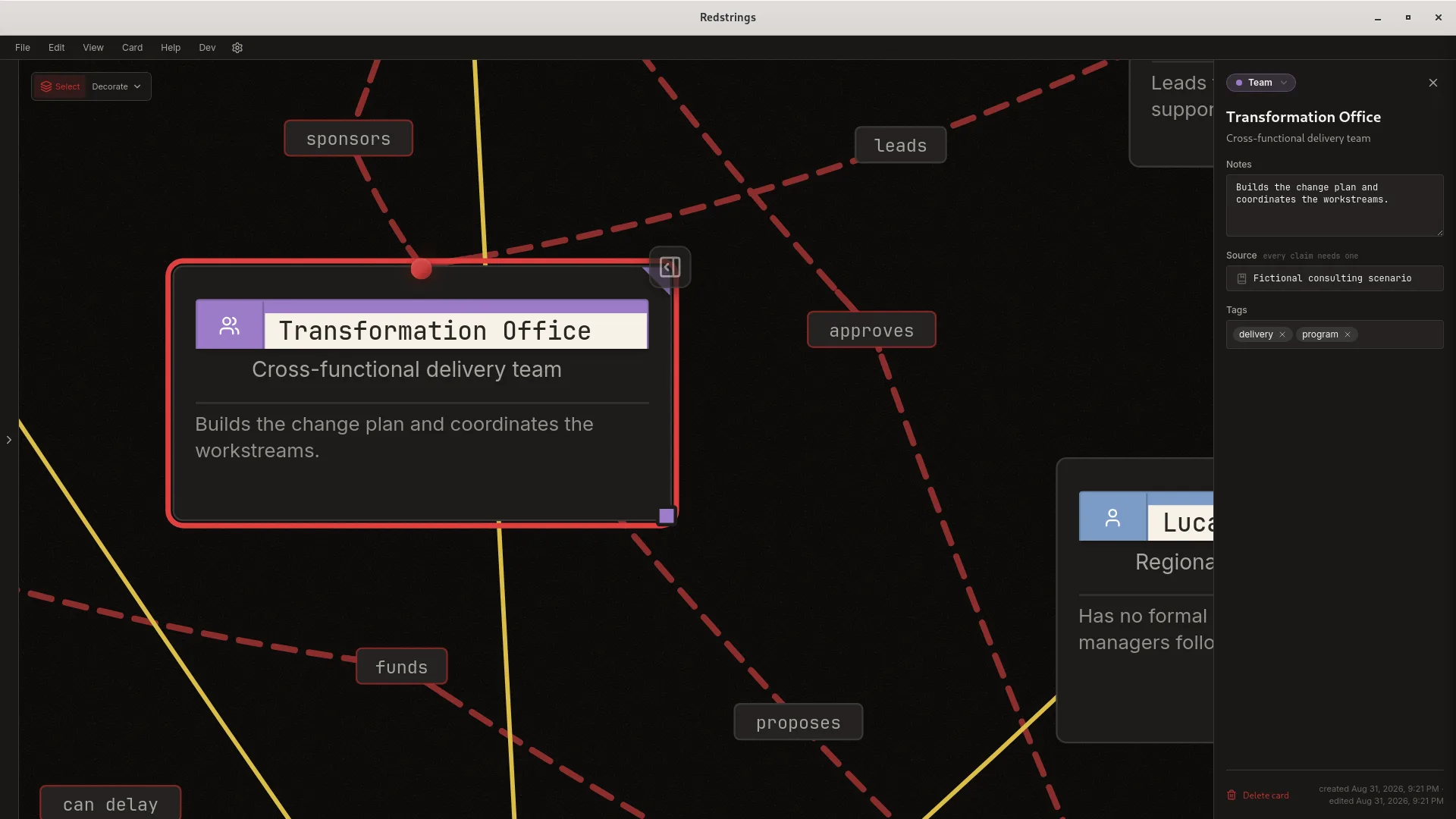
How to Create a Stakeholder Map
Step 1: Identify Stakeholders
Cast a wide net initially. Ask:
- Who has decision-making authority?
- Who controls resources (budget, people, access)?
- Who will be affected by the outcomes?
- Who has relevant expertise or information?
- Who has blocked similar initiatives before?
- Who are the informal influencers?
Step 2: Gather Information
For each stakeholder, understand:
- Role - Formal position and responsibilities
- Interests - What they care about, what motivates them
- Concerns - What worries them about your initiative
- Influence - Their ability to help or hinder
- Relationships - Who they trust, who they influence
Step 3: Map Relationships
This is the step that a list cannot do:
- Place stakeholders on a canvas
- Draw connections between related stakeholders
- Label each connection with the relationship type
- Position related stakeholders near each other
Step 4: Analyze the Map
Look for patterns:
- Centrality - Who has the most connections?
- Clusters - Which stakeholders group together?
- Gaps - Who should be connected but isn't?
- Paths - How do you reach key decision-makers?
- Risks - Where are the potential blockers?
Investigators read case boards the same way. Thelink analysis guide covers the method in more detail.
Step 5: Plan Engagement
Based on your analysis, create an engagement strategy:
- Prioritize high-power, high-interest stakeholders
- Identify allies who can influence skeptics
- Plan specific conversations to address concerns
- Build relationships before you need them
Step 6: Update Continuously
A stakeholder map goes stale fast:
- Update as you learn new information
- Track changes in stakeholder positions
- Add new stakeholders as they emerge
- Note successful (and unsuccessful) engagement tactics
Stakeholder Mapping Best Practices
Go Beyond the Org Chart
Formal hierarchy tells you who reports to whom. It doesn't tell you who actually makes decisions, who has informal influence, or whose opinion really matters. Your stakeholder map should capture the real power structure.
Track Your Sources
When you note that "Sarah influences the CFO's decisions," record how you know that. Did you observe it? Did someone tell you? Source tracking helps you assess reliability and remember context.
Include Relationship Quality
Not all relationships are equal. Note whether relationships are:
- Strong or weak
- Positive or contentious
- Professional or personal
- Recent or historical
Consider Hidden Stakeholders
Some important stakeholders aren't obvious:
- Executive assistants who control access
- Long-tenured employees with institutional knowledge
- External advisors or board members
- Unions, works councils, and regulators
Keep It Private
Stakeholder maps contain sensitive assessments of people and relationships. Use a local-first tool when the map should stay on one machine. Keep the project folder out of cloud sync.
Stakeholder Mapping Software
Several approaches to stakeholder mapping software:
- Spreadsheets - Fine for the list. Poor at showing who connects to whom.
- Presentation tools - Good for sharing static maps. Hard to maintain.
- Whiteboard tools (Miro, Mural) - General-purpose canvases. Templates exist, but relationship data is whatever you type on a shape.
- Stakeholder engagement platforms - Products such as Simply Stakeholders and Borealis log meetings and contact history across many stakeholders and projects.
- Relationship mapping tools - Purpose-built for visualizing connections.
For a map you will keep updating, look for:
- Easy relationship visualization
- Labeled connections
- Notes and metadata on each stakeholder
- Privacy (local storage preferred)
- Search and filter capabilities
What Is the Best Tool for Stakeholder Mapping?
No single tool is best for every job. Match the tool to what the map must do:
- A one-time matrix for a slide: a spreadsheet or presentation tool is enough.
- A live workshop with a group: a shared whiteboard lets everyone move sticky notes at once.
- Engagement records across a large program: a stakeholder engagement platform keeps a log of each contact.
- A map you keep updating, with labeled relationships, sources, and private notes: a relationship mapping tool such as Redstrings.
Redstrings keeps each board as a local file on one machine. If several people must edit one map at the same time, a shared whiteboard is the better fit.
Why Redstrings for Stakeholder Mapping?
Redstrings fits stakeholder mapping:
- Person and Team cards - Built-in types for stakeholders and groups
- Labeled strings - Document relationship types: "reports to," "influences," "trusts"
- Notes and sources - Track what you know and where you learned it
- Confidence levels - Mark each string Confirmed, Suspected or Uncertain
- A free canvas - Arrange cards in four areas to lay out a power/interest matrix, then draw the relationships across it
- Local files - Boards stay on your machine by default. Optional AI analysis in Pro sends selected board content to Google using your own Gemini key.
- Visual investigation board - Zoom to fit shows the whole board on one screen
Download Redstrings free and start mapping your stakeholders.
Frequently Asked Questions
What is stakeholder mapping?
Stakeholder mapping is the process of identifying the people and groups who affect or are affected by a project, then recording their interests, influence, and stance, and how they relate to each other. The result is usually a visual map or a power/interest matrix.
How do you do stakeholder mapping?
List everyone with a stake in the work. Record each stakeholder's role, interests, concerns, and influence. Place them on a power/interest matrix to set engagement priorities. Then draw the relationships between them, label each one, and note where the information came from. Review the map as the project changes.
What is the best tool for stakeholder mapping?
It depends on the job. A spreadsheet or slide is enough for a one-time matrix. A shared whiteboard suits a live workshop. A relationship mapping tool such as Redstrings suits a map you keep updating, where labeled relationships, sources, and privacy matter. Dedicated stakeholder engagement platforms suit organizations that log contact with many stakeholders across many projects.
What is stakeholder mapping in project management?
In project management, stakeholder mapping is part of stakeholder analysis at the start of a project. It identifies whose approval, resources, or cooperation the project needs, sets how closely to engage each group, and feeds the communication plan. The map is revisited at each phase because stakeholders change.
What is the difference between a stakeholder map and a stakeholder matrix?
A stakeholder matrix places each stakeholder on two scales, usually power and interest, to set engagement priorities. A stakeholder map also shows the relationships between stakeholders: who reports to, advises, funds, or blocks whom. Most projects use both.
Is there a free stakeholder mapping template?
Yes. This guide includes a stakeholder mapping template with card types, relationship labels, confidence levels, and a stakeholder analysis record you can copy. The free version of Redstrings supports all of it.