A murder board is a wall of photos, notes, and documents about a crime, with red string running between the pieces that connect. The victim sits in the middle. Suspects, witnesses, places, and events spread out around them. Every crime drama has one, usually in the scene where the detective stares at it until something clicks.
People build them outside of television too. True-crime fans use them to follow a case through a podcast or documentary. Mystery writers use them to keep track of clues and suspects. Hosts of murder mystery games use them to check that the solution holds together.
Murder Board, Detective Board, Evidence Board
These names all describe the same thing: cards on a surface, joined by lines that show how they relate. "Murder board" is the name people use when the subject is a crime story, real or invented. The general version, used by investigators, consultants, and analysts, is covered inWhat Is a Detective Board? This page is about the crime-story kind.
What Goes on a Murder Board
- The victim. The center of the board. Everything else connects back here.
- Suspects. One card each, with motive, means, and opportunity in the notes.
- Witnesses and other people. Family, friends, coworkers, anyone who saw or said something.
- Places. The scene, the last known location, homes, workplaces, vehicles.
- Events. Times and dates: last sighting, phone calls, arrests, trial dates.
- Evidence. Physical evidence, documents, recordings, statements.
- Open questions. Notes for what is missing. These are often the most useful cards on the board.
The strings matter as much as the cards. A string with no label only says that two things are related. A string labeled "last seen with," "alibi from," or "owns" says how they are related.
Who Makes Murder Boards?
True-Crime Followers
A long case has dozens of names, several locations, and a timeline that runs over years. Podcasts and documentaries deliver it one episode at a time, often out of order. A board keeps all of it in one place, so episode eight's new witness goes next to the people they knew.
Mystery Writers
A whodunit has to be fair. Each clue needs to be planted before the reveal, and each suspect needs a reason to look guilty. A board shows which clues point to whom, which red herrings lead where, and which characters know what at each point in the story. Thecharacter relationship chart guide covers the wider cast, and the plot diagram guide covers structure.
Murder Mystery Game Hosts
Murder mystery parties and tabletop mysteries break when one clue contradicts another. Laying the whole solution out on a board before game night shows the gaps while there is still time to fix them.
TV and Film Fans
Mystery series reward people who track details across a season. A board per show keeps theories and evidence apart, so you can see which theories still fit after each episode.
How to Make a Murder Board
Step 1: Put the Victim in the Center
Start with one card for the victim or the central event. Add the date and place of the crime to its notes.
Step 2: Add the People
Add a card for each suspect and key witness. Connect each one to the victim and label the string with the relationship: "spouse," "business partner," "neighbor," "found the body."
Step 3: Build the Timeline
Add event cards for the moments that matter, with dates and times. Connect people to the events they were part of. Gaps in the timeline show up quickly once the events are on the board.
Step 4: Attach the Evidence
Add evidence cards and connect each one to the people and events it involves. One piece of evidence with strings to three suspects is worth a closer look.
Step 5: Separate Fact from Theory
On a board, a rumor from a forum and a fact from a court record look the same. Mark every connection as confirmed, suspected, or uncertain, and write down where it came from: "Episode 4, 12:30" or "Police affidavit, page 3." When a theory falls apart, you can see what it rested on.
Step 6: Step Back and Look for Gaps
Once the board has 20 or 30 cards, zoom out. Who connects to everyone? Who connects to no one? Which hour of the timeline has no events? Write each gap down as an open question.
The same method, applied to evidence in general, is in theevidence board guide. For tracking several cases at once, see the case board guide.
Physical or Digital?
A corkboard is satisfying to build, but it runs out of space, it is hard to rearrange, and you cannot search it. It also stays on the wall where visitors can read it. A digital board can be larger than a wall, cards move without re-pinning string, and search finds a name in seconds.
A Note on Real Cases
A true-crime board is about real people, many of them still alive and some never charged with anything. Keep theories marked as uncertain, keep a source on each card, and read the whole board before you post it anywhere public.
Make a Murder Board in Redstrings
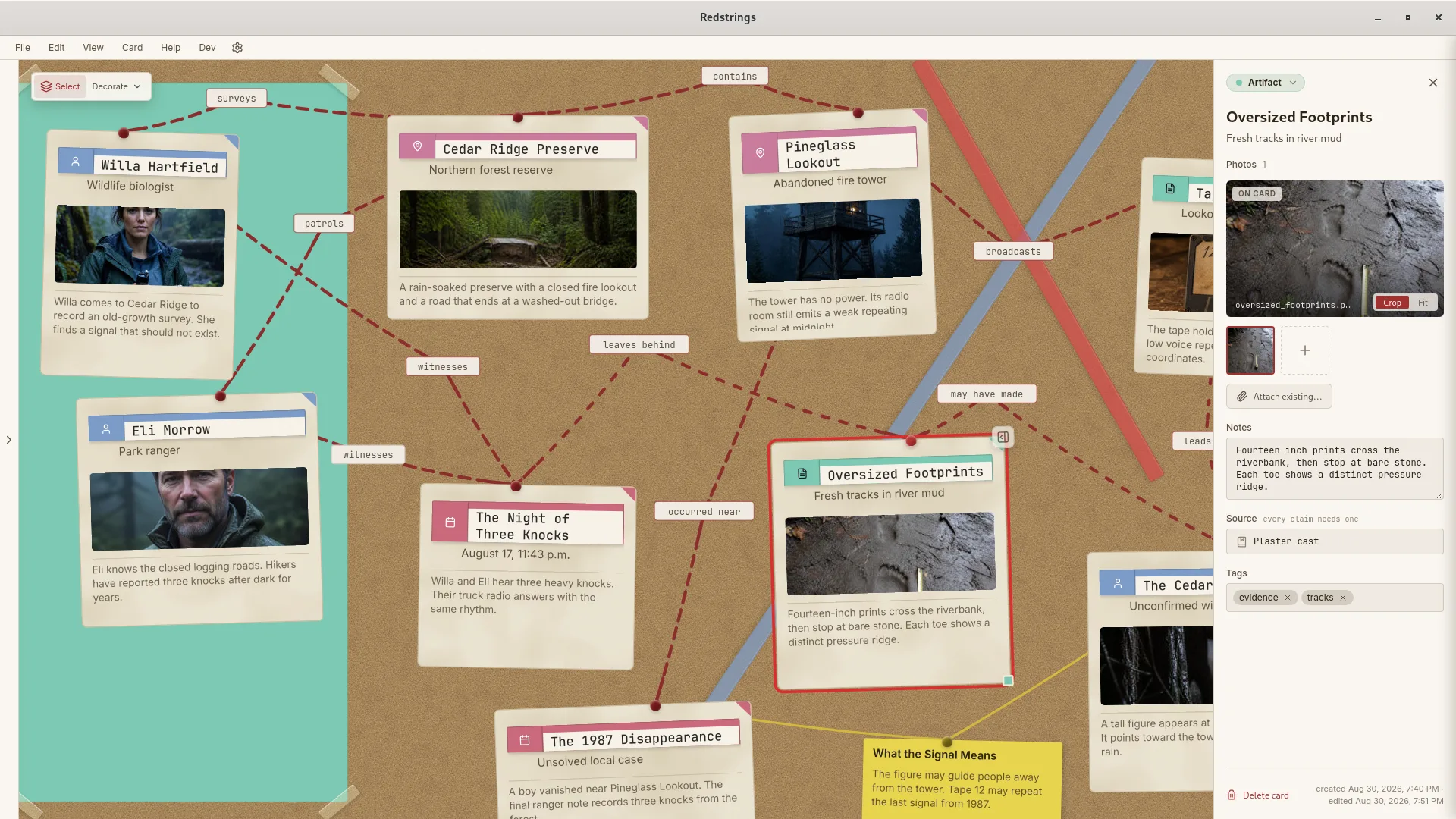
Redstrings is a red string board for Windows 11 and macOS. It works like a murder board: cards on a board, joined by labeled strings.
- Card types for people, places, events, documents, and notes, with photos on people and places
- Labeled strings with confirmed, suspected, and uncertain confidence levels
- A source and tags on every card, so each fact keeps its origin
- Several boards in one project, for example one per suspect or one per season
- Local files, with no account needed to build a board
- Free for unlimited boards, cards, and strings. Pro is a $19.99 one-time purchase.
Try the demo in your browser, ordownload Redstrings free and build your first murder board.
Murder Board FAQ
Is a murder board the same as a detective board?
Yes. "Murder board" is the name used for crime stories, and "detective board" or "evidence board" is the general name. The method is the same.
Can I make a murder board for free?
Yes. The free version of Redstrings has no limit on boards, cards, or strings.
Can I share a murder board?
Yes. You can export a board as a PNG image or a Markdown report. With Pro, File → Share Project… publishes the project to a link that anyone can open in a web browser.