The concept mapping guide explains how to label connections between ideas. Pair your character map with a plot diagram to track when those relationships change.
A character relationship chart maker gives you one place for the cast, their secrets, and the trouble between them. After a story has more than a dozen names, it gets hard to remember who knows what about whom.
Put each character on the board and draw the relationships you need to remember. A character with no connection, or two characters who should have met but never did, becomes easier to spot.
Why Visual Character Mapping Works
Writers have always used visual tools: index cards on corkboards, story webs on whiteboards, character sheets in binders. A digital board keeps those methods and adds a few things paper cannot do.
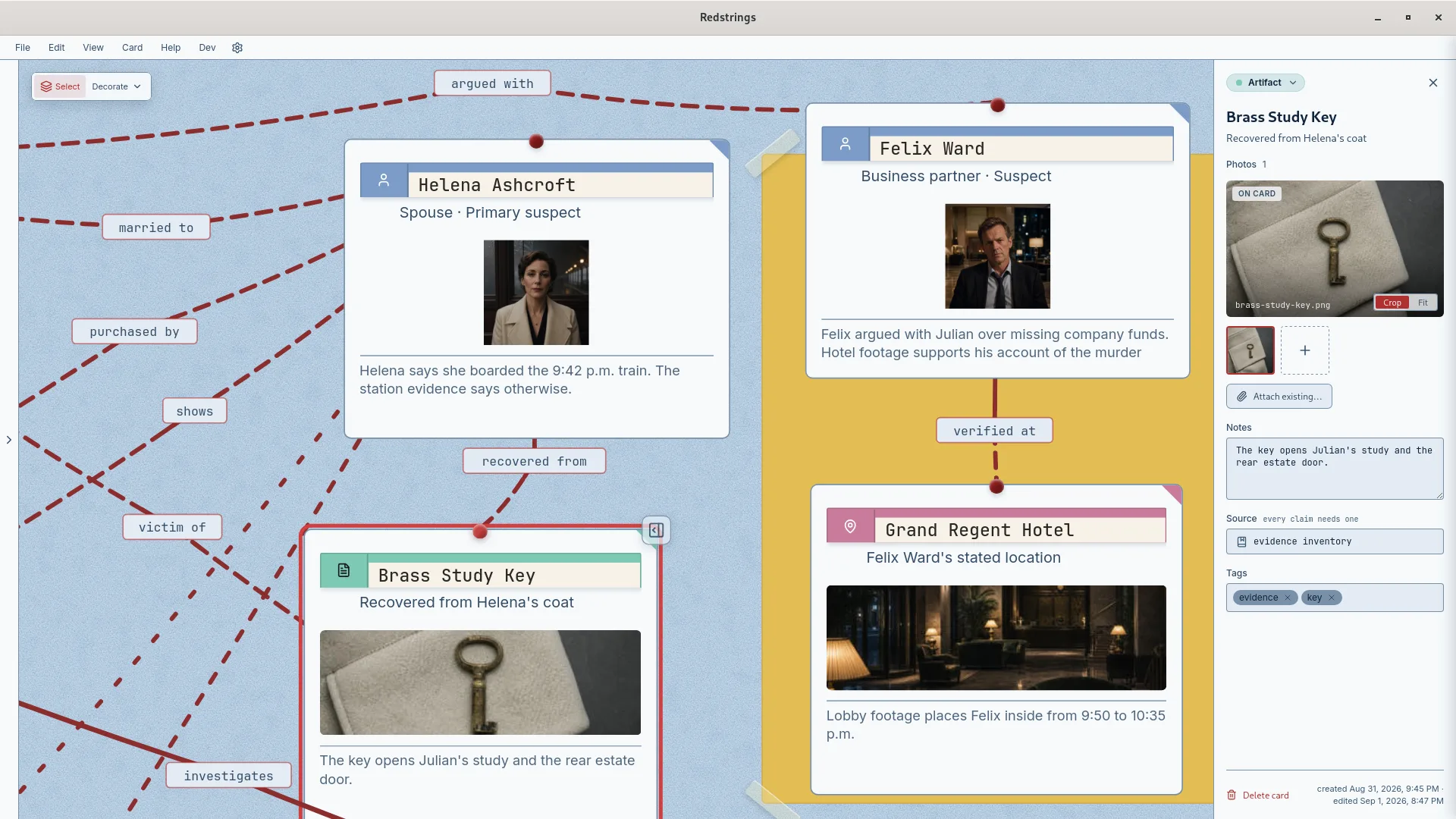
Zoom out and read the whole cast. Label strings as "mentor to," "rivals with," "secretly in love with," or "betrayed by." Export the Markdown report and you have a relationships table for the story bible.
Sort the cast by role. Tags work on the free tier; Pro adds custom card types with their own colors, so protagonists and antagonists can look different at a glance. A project can use one board for character relationships, another for faction politics, and another for the chain of events.
Make a character relationship chart
Start with names and lines. Family trees track ancestry. A relationship chart can also hold alliances, debts, secrets, and old grudges.
- Add a card for each important character.
- Put the protagonist near the center, then group the rest by faction, family, or storyline.
- Label each string with the relationship: "owes a debt to," "hides from," or "raised by."
- Add Event and Artifact cards when a past betrayal, letter, or missing object changes the relationship.
Leave space on the board. A later draft may introduce a character who changes the whole arrangement.
Use Cases for Writers
Novel Writing
For novelists writing series or large casts, a relationship map earns its keep. Map your POV characters in the center, then branch out to secondary characters, showing how each one connects to the core cast. As your story develops, add new connections to track how relationships evolve.
Tip: Record how a connection changes over the story. The string from Sarah to Mark can carry the label "colleagues" early on and "lovers" later, with the change noted in the string's notes field.
Screenwriting
Film and TV writers need to track relationships across scenes and episodes. Which characters have never met? Where are the dramatic opportunities when enemies are forced to work together?
Fantasy and Sci-Fi Worldbuilding
Worldbuilders track more than characters:
Worldbuilders also track factions and who runs them, which places matter and what happened there, past events that shape the present, and who knows about or holds which artifact.
One board can hold a fictional universe: Person cards for characters, Team for factions, Place for locations, Event for history, and Artifact for the objects that matter.
Game Masters and RPG Campaign Planning
Dungeon Masters and Game Masters running tabletop RPGs need to track NPCs, factions, quests, and player relationships. Investigation boards let you:
- Map NPC relationships before the session
- Tag what the players have found so far and what is still hidden
- Plan how factions will react to player actions
- Keep a visual record of campaign history
How to Map Character Relationships
Here's a practical approach to mapping your story's relationships:
Step 1: Start with Your Protagonist
Place your main character in the center of the board.
Step 2: Add Core Relationships
Who does your protagonist interact with most? Add these characters as cards, connected to the protagonist with labeled strings. Be specific. "Childhood best friend" or "reluctant ally" tells you more than "friend."
Step 3: Build Outward
For each secondary character, ask: who else are they connected to? Your protagonist's mentor might have a former student who's now an antagonist. Your love interest might have an ex who's about to complicate things.
Step 4: Identify Clusters and Gaps
Step back and look at your board. Do you see groups of tightly connected characters with few bridges between them? Groups with no strings between them either need a bridging character or are the two sides your conflict will run between. Decide which, and add the string or leave the gap on purpose.
Step 5: Map the Events
For complex stories, create a second board that maps events instead of characters. Connect events to show cause and effect, and link characters to the events that shaped them.
Examples
Consider how these famous stories would look as relationship maps:
- Game of Thrones - Houses as Team cards, characters within, alliance and rivalry strings between houses, plus marriage and blood strings between individuals.
- The Lord of the Rings - The Fellowship as a tight cluster, with connections spreading out to the various kingdoms, factions, and historical figures.
- Murder mysteries - The victim at center, with every suspect connected, their alibis, motives, and relationships mapped out.
Why Use Investigation Board Software for Writing?
Scrivener manages the manuscript and has a corkboard for arranging scene cards, but it does not draw labeled connections between them. An investigation board does one thing: it puts every character on one surface and shows every relationship as a line you can read.
Redstrings is a red string board for this kind of visual work. Person, Place, Event, and Artifact cards hold the cast, settings, plot points, and objects that matter. Pro adds custom types and colors.
Label the strings and use separate boards for character maps, event chains, and faction politics. Boards are local files, so drafts stay on your machine. Optional AI analysis in Pro sends the board to Google with your own Gemini key. The board looks like a detective's corkboard: cards, strings, and tape.
Getting Started
If you're a writer struggling to keep your character relationships straight, or a worldbuilder with more lore than memory, try visual relationship mapping. Start with your main character, add their closest connections, and let the board grow organically as your story develops.